Categories
Arrangement Choir Church Commissions Congregational Songs Live

Mary’s Song, live at Baylor University

It’s so much fun to work with friends! In this case, my friend Carlos Colón commissioned me to write an arrangement of “Mary’s Song,” a song written by another friend, Wendell Kimbrough. This beautiful performance was recorded at a rehearsal for a chapel service at Baylor University.

Categories
Arrangement Church Congregational Songs Live

Holy Is Your Name

The Canticle of Mary (the Magnificat, Luke 1:46-55) is one of the most beautiful prayers in the Bible. It has elements of meekness, joy, obedience, wonder, and even some revolutionary overtones. It is no surprise that every music setting brings out different aspects of the text.

This anonymous text and Scottish folk tune pair beautifully to show a young girl whose hope has been steeped in the prophecies long enough that she believes the angel’s surprising message.

This arrangement for voice, guitar, and strings was written for a service at Rosewood Church that focused on Mary. With a melody this lovely and honest, the best thing you can do is avoid gilding the lily. Hence, a simple arrangement that swells at each chorus and remains understated during the verses.

I will soon write a piano accompaniment and make it available at my website.

Categories
Arrangement Church Live

It Came Upon a Midnight Clear

Just in time for Christmas 2025 is a brand new arrangement of “It Came Upon a Midnight Clear.”

First, a disclaimer: this recording is very rough, recorded live in worship after an hour-long rehearsal, direct from the soundboard.

Some songs are blank canvases on which one can paint their own personality. Not so, this carol. The melody dips in and out of a chromatic backdrop, establishing certain non-negotiables for the arranger. And yet, the song is marked by its quiet simplicity. I wanted to retain that serenity in my arrangement.

This arrangement was written for the All Saints Orchestra (guitar and string quintet), but I later added a piano part for churches with more standard instrumentation.

Categories
Church Congregational Songs Demos Psalms

Psalm 72: Hear Our Prayer

If you need a musical setting of Psalm 72, you can’t do much better than Isaac Watts’ “Jesus Shall Reign,” in which he recasts the messianic king of the Psalm in the person of Jesus. What more can be added to his triumphant text set to the fanfaric tune, DUKE STREET?

Linda Bonney Olin took a very different tack in setting Psalm 72 to verse. Instead of interpreting the royal blessings of “Endow the king with your justice” and “may he defend the afflicted,” as the future deeds of a messianic monarch, she interprets them as acts that all of God’s people can, and should do–right now. And her hymn prays to that effect: “Hear our prayer for the ones you’ve called to rule, to judge, to guard, and to govern. Not to get all political, but I wish today’s leaders–especially the Christian and Jewish ones–would take this to heart. That they would focus on wisdom, mercy, humility, and defending the oppressed.

1. Hear our prayer, O Lord our God,
for the ones you’ve called to rule,
that your power and your wisdom they may share.
As a withered meadow blooms in a sweet, gentle rain,
may your people grow and flourish in their care.
Hear our prayer.

We lift them up to you, O Lord our God.
We lift them up to you.
Hear our prayer.

2. Hear our prayer, O Lord our God,
for the ones you’ve called to judge,
that your righteousness and mercy may prevail.
May they spare the friendless poor and defend the oppressed, weighing justice on a true, impartial scale.
Hear our prayer.

3. Hear our prayer, O Lord our God,
for the ones you’ve called to guard,
who protect the world from enemies of peace.
Give them courage; give them strength to stand up for the weak
till all violence and senseless bloodshed cease.
Hear our prayer.

4. Hear our prayer, O Lord our God,
for all those that you entrust
with authority to govern and to guide.
May they humbly seek to lead in the ways you command,
that your name alone, O God, be glorified.
Hear our prayer.

Categories
Art Music Commissions Demos

Grandfare

This summer, I was commissioned by the Grand Rapids musicians’ union to compose a fanfare for our 120th anniversary. The parameters were: a 2-minute (120 seconds–see what they did there?) fanfare scored for a mixed ensemble of brass, winds, and percussion not to exceed the instrumentation of Aaron Copland’s “Inaugural Fanfare,” which would also be on the program. I only had a month to go from blank page to completed score and parts, so I knew I had to get busy.

But first: what is a fanfare?

Intuitively, I understood a fanfare to be a festive, trumpety thing, but I started to second-guess myself. Was there a secret recipe that everyone knew but me? (I’ve been composing for forty years, and I am still susceptible to impostor syndrome.) After a good deal of research, I confirmed that a fanfare is, indeed, a festive, trumpety thing. It has no precise definition, but there are plenty of examples: Copland’s “Fanfare for the Common Man” is something of a gold standard, as is John Williams’ “Olympic Fanfare and Theme.” One of my personal favorites is Leoš Janáček’s “Sinfonietta.”

The challenge was to compose something regal and courageous, immediately accessible to listeners, playable by performers with a half hour rehearsal, and that says everything it needs to say in a very short time.

I gravitated toward a more-or-less tonal palette, but kept it from being obvious or saccharine by using lots of stacked fifths/fourths (for openness) and non-harmonic tones (for bite). Of course, I relied heavily on the trumpets, but every section is featured at some point. I also had a ton of fun with the percussion, including Glockenspiel, Xylophone, Tubular Bells, Brake Drum, Crotales, China Cymbal, Cabasa, Vibraphone, Tam-tam, Suspended Cymbal, Crash Cymbal, and Drum Set. Finally, I played with style. The GR music union is made up of musicians of all genres: classical, blues, jazz, rock, etc. So, I used drum set to establish a pop groove in the middle of the fanfare, with jazz style voicings on top of it.

I was really pleased with how it turned out–a tasty little slice of musical cake.

Categories
Arrangement Commissions Demos Global Live

HSU MUU: Inevitable Adiós

The final arrangement for the Holland Symphony Orchestra’s “Music Unites Us” concert with Grupo Super Nova was a ballad called “Inevitable Adiós.” It is gorgeous and heartbreaking.

When Christian, the songwriter, first sent me this, I responded, “I don’t understand half of the Spanish, and I was still getting choked up!” With a song like this, the best thing to do is just stay out of the way. Let the song speak for itself; simply support and enhance what is already in the music. I did that with lush lower strings, regal horns, soaring violin lines, harp, and lots of cymbal rolls.

Of course, I needed to let the orchestra come to the foreground at some point. I did this with an oboe solo, a flugelhorn solo, and a trumpet/trombone duet. Just enough of a break to leave us wanting more.

I’m usually not one for modulations. They are so often used as a cheap way of inflating energy back into a mediocre song that I normally stay clear of them. But I made an exception here. I let the song wind down as if it were ending, but instead of the quiet tag of “Inevitable adiós” that we expect–BAM!–a sudden modulation into a new key with full orchestra. It’s glorious, if I don’t say so myself.

Below is video of me accompanying Christian on guitar at the concert.

Categories
Arrangement Commissions Demos Global Live

HSO MUU: Escucha

The next arrangement for Grupo Super Nova and the Holland Symphony Orchestra was “Escucha.” This song, too, is in an upbeat Cumbia dance style, but the lyrics are poignant: “Listen! I want you to pay attention, just in case today is our last day together: I love you like I have never loved before.”

This arrangement is further outside the box than the others. I ask the violins to strum their instruments like ukeleles and play a melody on one string with one finger (to match the portamento of the synth line). Later is a duet between electric guitar and electric violin. Then I ask the orchestra to sing background vocals. All of these stretch the musicians out of their comfort zones, but since we had worked together previously, I decided there was enough trust for them to try these unusual effects with a minimum of grumbling.

One of my favorite sections is when all the motion stops and Hector sings a quiet refrain in English. I didn’t want the English-speaking audience to miss the poignant message of the lyrics. Too, a short silence makes what follows sound even more energetic.

I should make a note about how I created these demos. I use Dorico for my notation software. To make a demo of the arrangement, I play Dorico through orchestral playback software called NotePerformer. NP is unique in that it interprets the score as orchestral musicians would play it, with articulations, blend, and reverb as they would happen in an actual performance. (Who says AI is bad?) From there, I load my orchestral arrangement and Grupo’s original recording into Logic Pro. After a bit of tempo matching and splicing I can produce a decent demo of how the final performance might sound. This is really important when trying to get buy in from both note-readers and ear-performers. It allowed everyone walk into rehearsal with a very good idea of how it would sound.

Below are a few snippets of video from the concert. There aren’t a lot of composers who can say people dance to their orchestrations!

Categories
Arrangement Commissions Demos Global Live

HSO MUU: Lo mejor de mí vida

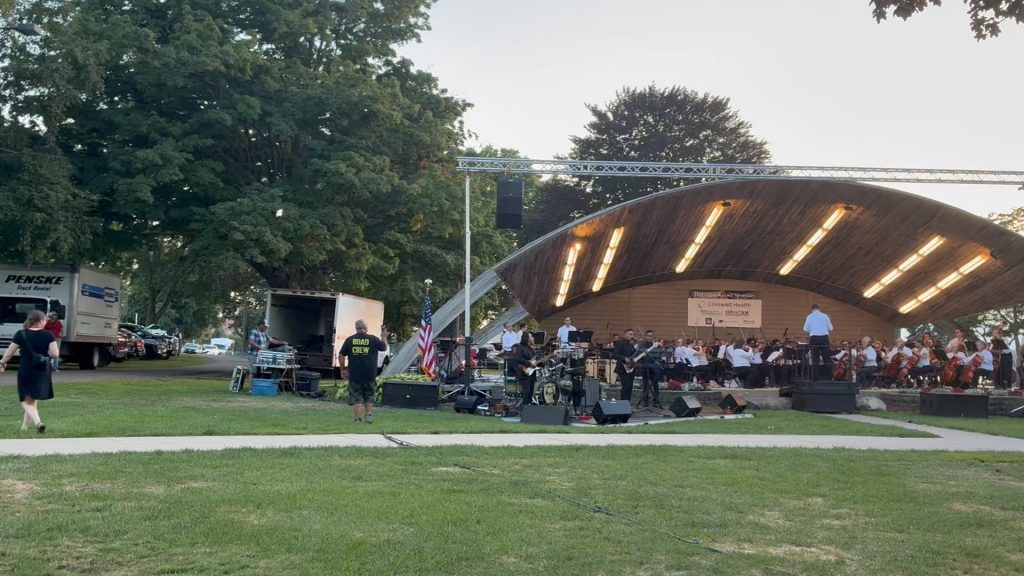
I recently wrote three new arrangements for the Holland Symphony Orchestra’s “Music Unites Us” concert on August 9, 2025. In this outdoor concert, Grupo Super Nova, a Mexican Cumbia group from Holland, performed their original songs with the orchestra. My next three posts will be the arrangements from that concert.

Greg with the Garcia brothers.

The original “Lo mejor” (link below) keeps up a mid-tempo dance groove throughout. In each of these songs, I was looking for ways to create a dialogue between band and orchestra, rather than keeping the orchestra in a purely accompaniment role. So, on this song, I decided to begin with an extended, dramatic introduction before it kicked into its dance groove. Once the beat drops, the orchestra plays an accompaniment role, until…

Surprise! It’s a tuba solo. In the Mexican Banda style, tubas play a prominent role. I decided to tip my hat to that tradition by starting the mid-song breakdown with a tuba solo. Then comes a long build, beginning with the violin, moving through the strings, and then joined by all the bass instruments. After a quick recap of the chorus, the song concludes.

Sadly, I didn’t get a good video recording of the event. You will have to be satisfied with a demo of an early draft of the score. Email me if you’d like to take a look at the score.

Categories
Art Music Choir Church Commissions Live Psalms

Let the Peoples Praise You

From 2000 to 2005, I worked at Northwestern College in Iowa, teaching music and worship in the music department, and leading chapel worship and overseeing worship teams for campus ministries.

In my second year there, a new president was inaugurated, and I was commissioned to compose a piece for the ceremony. I hadn’t thought about it much in the few decades since, but I recently found a recording from the inauguration and decided to clean it up and post it here.

I had forgotten how much I like it!

The lyrics are adapted from Psalm 67–a perfect Psalm of thanksgiving for a fall worship ceremony in the heartland of America. The meter is 7/8 throughout. I never strayed from a 2+2+3 rhythm; still, the choir hated me for the odd meter! The rhythmic vitality really drives the piece; it feels exciting and exuberant. The harmonic style is–I don’t know what to call it–pan modal? But I like it. There is a lot of bite in the harmonies, but they’re not so complicated the choir can’t find their notes or it leaves the audience scratching their heads.

It feels like it was an important step forward in my composing.

Categories
Quirky

Rocky and Sandy Theme Song

Many, many moons ago, I worked at a church that insisted I take part in Vacation Bible School. I was frightened by children, especially large groups of them. I was even more afraid of people who enjoy working with large groups of children–those who assure you how much fun you’re going to have wearing a “Steamroller Scheer” hard hat and singing “Peace Like a River” every day for a week.

This was before Simon was born, so maybe around 1998. It was also before computers could process audio efficiently, so I made recordings on the 3×3″ screen of a VS880 using my one microphone, Finale playback, and a Roland keyboard.

And so, from the ooze of this primordial audio swamp, “The Rocky and Sandy Theme Song” was born. It is a hyperactive little musical bonbon that would have been a hit as the intro music for a Saturday morning cartoon. Alas, it enjoyed 42 seconds of fame in a hall full of screaming children, and was quickly drowned out by the sound of a go-cart one of the VBS leaders insisted on driving up to the stage.