This is, literally, my musical diary–notes fresh from my pen and recorded in a few hours. You can find my finished works elsewhere; here, it's all about capturing the moment!
One of my greatest joys is when a song takes on a life of its own and begins to travel to unexpected places and people. My setting of Simeon’s Song, “Lord, Now Let Your Servant Depart in Peace” was recently sung in Bahasa (Indonesian) and Chinese translations at GKY Mangga Besar Church in Jakarta.
GKY Mangga Besar
My friend, Lucky, was behind this. I met Lucky in 2015 when I was in Indonesia and he was just about to head to Grand Rapids to study at Calvin Seminary. His family and mine became close while he was in town. I was sad to see them return to Jakarta, but knew that God had big plans for them back at the GKY Church. This Christmas he decided to introduce my song to his congregation, and you can hear that his people really took to it.
One of the things I loved about worship in Indonesia is that people sing with all their heart. In this recording, you can hear the pastors urging on the congregation, and the people responding with full voices. I believe I’m also hearing a pipa (a strummed Chinese instrument that sounds a little like a mandolin tremolo) in the chorus, which sounds surprisingly good.
Here is the recording of “Savior of the Nations, Come” performed at Baylor University’s 2017 Lessons and Carols service. I wish I could have been there in person. It sounds beautiful.
World Library Press now publishes “Clap Your Hands,” a Yoruba folk song I arranged for SATB Choir, Cantor, Flute/Piccolo and Percussion. Even better, they recorded a beautiful rendition of the arrangement that shows they really get the piece.
This is a great choice if you’re new to singing global music with your choir or if you want to highlight a flute player or percussionist. Added bonus: It’s based on Psalm 47, the Psalm for Ascension Day. Order it now so your copies will arrive in plenty of time to prepare for May 10!
Update 12/11/21: Sheet music for this song is now available at gregscheer.com.
For the fourth year in a row, I’ve been commissioned to write a piece for Calvin College’s Lessons and Carols service. Not only is it an honor, but it’s always a treat because I know the performances will be top-notch. This year was no exception. Calvin’s musicians did a wonderful job with my choral fantasy on the hymns “Lo, How a Rose E’er Blooming,” “Ah, Holy Jesus,” and “All My Heart Again Rejoices.”
Calvin College 2017 Lessons and Carols: Born to Die, Born to Rise
It seems that each year the commissions become more difficult. Last year I was asked to weave “Jacob’s Ladder” with a variety of “Gloria” songs; difficult, but at least the songs were similar in nature. This year, I almost thought John Witvliet was jerking my chain when he asked me to put “Lo, How a Rose” and “Ah, Holy Jesus” together in one anthem. You couldn’t find two more different songs!
On the other hand, they fit the theme, “Born to Die, Born to Rise” beautifully. Christmas can become saccharine when it’s populated only with sweet baby Jesuses, choruses of angels, and mild Marys. Just as the Magis’ myrrh foreshadowed Jesus’ burial, “Ah, Holy Jesus” reminds us of the full meaning of the incarnation. As I began to work on the piece, I found that I could weave “Lo, How a Rose” and “Ah, Holy Jesus” together in musical counterpoint that thickened both their differences and underlying unity. After focusing on these two sides of Christ, our only response can be praise; the piece ends with a rousing rendition of “All My Heart Again Rejoices.”
The recording is above. Follow the link above if you’d like to see the score.
Update 10/2/20: Sheet music for this song can be downloaded here.
You may have heard that I won the 2017 Church of the Servant New Psalm Contest with my Psalm 40 song, “Patiently.” What you may not have heard is that I lost the contest with my Psalm 55 song, “Oh, That I Had Wings.”
It’s understandable that my setting of Psalm 55 didn’t win. It is not the most endearing Psalm in the Psalter. It’s the plea of someone who has been betrayed and attacked by a former friend. Understandably, the Psalmist wants to beat a hasty retreat: “Oh, that I had the wings of a dove! I would fly away and be at rest.” These are emotions that most of us have faced, but perhaps few of us are interested in singing about them.
Given the urgency of the Psalm, I wrote a tune that comes in short, breathless bursts. The tight meter could have become trite, but there are lots of harmonic twists and turns to avoid that. The string arrangement on the recording (played by the St. Sinner Orchestra in one take into my laptop) creates a conversation with the melody that pushes the song forward. You can find the string arrangement as well as the piano version at the link above.
1. Listen to my prayer, O God, please hear:
troubled thoughts rise from a heart of fear;
Fear of those who would undo my days—
the whispers, stares, contempt, the lies and rage.
Oh, that I had wings, Oh, that I had wings to fly, Oh, that I had wings to fly away.
2. Malice seeks its prey, it roams the streets.
Night and day, it prowls— there is no peace.
God, please let the innocent escape,
while schemers writhe within the traps they’ve laid. (refrain)
3. Bracing for the sword of foe’s attack,
feel the steel of dagger in my back.
Why have you betrayed me, oh my friend?
The one with whom I’ve shared the wine and bread? (refrain)
4. Night and day, I pray, O God, please hear:
troubled thoughts rise from a heart of fear.
Every care that weighs upon my soul
is safe with you, please keep me safe, O Lord. (refrain)
Carlos and I being served drinks by a statue in Indianapolis.
Update 10/28/21: Sheet music for this piece can now be purchased at gregscheer.com.
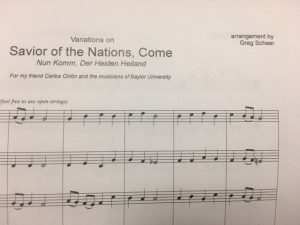
My friend Carlos Colón directs worship at Baylor University. He recently asked if I had anything for string quintet that might work as an interlude for an upcoming Advent service. And he needed it quickly. I sent him a few ideas, including this fugal intro to the Advent hymn, “Savior of the Nations, Come.” I thought I was going to be able to simply adapt what I had written before, but once I got started it was clear that I needed to rewrite it from the ground up. Two days from inquiry to completed score. That’s how I roll.
E.H. Plumptre, author of “Rejoice, Ye Pure in Heart.”
Update 11/4/21: Sheet music for this song can now be downloaded at gregscheer. com.
This hymn tune is another one that’s been hanging out in my idea folder for far too long. From the very beginning, the refrain was just how I wanted it: a perfect wedge of notes that vibrated with dissonant energy. The verse, however, was another story. It went through 3 or 4 entirely different drafts before I was satisfied.
What I like most about this hymn tune is that it twists, turns, and teeters on the edge of chaos without ever losing its melodic momentum. Let’s if you agree.
I would be very pleased to turn this into a festive choral anthem with organ and brass. If your church commissions it, you get to name the hymn tune! Alternately, if you want to write a new hymn text (6.6.8.6 with refrain) to this tune, I’d be happy to collaborate with you.
Lately, a large part of my work for the Calvin Institute of Christian Worship has been translating and arranging Hispanic worship songs for the forthcoming bilingual (Spanish/English) hymnal. These songs have included everything from the smooth pop praise of Marcos Witt to the joyous coritos that travel from church to church in Latin America and the USA, often changing as they go. I’ve completed almost 50 songs and have at least another 25 to go before my work is done.
To give you a taste of the project, my boys and I recorded “Oh, Jerusalén, que bonita eres / Oh, Jerusalem, How You Shine with Beauty.” The MP3 is above. You’ll just have to wait until the hymnal is published to see the music!
The Scheer Boys: they’re not only your favorite boy band, they’re a biking team!
Update 11/4/21: Sheet music for this song can now be downloaded at gregscheer.com.
Some songs come quickly. This one, however, took well over a year. It draws its inspiration from “I Hunger and I Thirst.” I liked how that hymn ties Old Testament stories to the communion table. At first I was going to simply write a new tune for this text, but soon my aspirations grew: I added a chorus, then I began to rewrite the original text, and soon it was a completely different song with the 8 “I am” titles for Jesus mapped out to 8 different Old Testament stories.
And then I got bogged down. I had pages of drafts for an epic (read: sprawling, unfocused) 8 verse hymn that said everything and nothing at all. When I came back to it recently, I decided that done is a lot better than perfect. I trimmed it down to 3 verses–bread, blood, water–and kept things tightly focused on the Table.
After listening to the recording, my son, Theo, declared that my songwriting is getting better. I hope so. I was especially pleased with the lyrics, which strike me as poetic without being unlyrical, supported by music which is harmonically “slippery” without losing singability. In any case, an uptempo modern communion song is certainly a welcome addition to the repertoire. My only regret is losing the word “gush” in the third verse after a long, intense rhyming battle to the more predictable “flow.”
Decide if Theo is right.
1. O Bread of Life, sustain,
with manna each new day;
and ease our hunger pangs
with food along the way.
For hunger hounds us still;
we faint, but you are kind.
Our hearts long to be filled
with you, O Bread of Life.
Behold, a table is spread— a feast for hungry souls. Come, eat the Living Bread. Come, drink the wine that flows.
He who bids us, “Come and dine,” is feast, and friend, and host. Come taste and see the goodness of the Lord.
2. O Spotless Lamb of God,
be yet again our life.
May your redeeming blood
run deep, and rich as wine.
Oh, let this new wine flow,
fruit from the one True Vine.
Let those who drink it know
a joy complete, divine. CHORUS
3. O Living Water, flow
in never ending streams
revive our withered souls
within the desert’s heat.
For still your people thirst–
parched are the throats that praise.
Let streams of mercy burst;
drench us with floods of grace. CHORUS
One of the most satisfying things about writing music for the church is to see how different songs migrate. “Abana/The Arabic Lord’s Prayer” is quickly becoming one of the most popular global songs I’ve translated and arranged. It was already a beloved song among Arabic-speaking Christians, and it strikes a deep chord with Western churches that are trying to embrace the communion of saints in an age of division.
My friend Denise Makinson at Southwood Lutheran Church in Lincoln, NE recently sent me this fine recording of her choir and instrumentalists introducing “Abana” to their congregation. Wonderful!