This is, literally, my musical diary–notes fresh from my pen and recorded in a few hours. You can find my finished works elsewhere; here, it's all about capturing the moment!
“By the Babylonian Rivers” is one of my favorite songs from Global Songs for Worship and one of my favorite Psalm settings in general. We used it at COS last week and I decided that the line “Lord God, hear your lonely band” fairly demanded an instrumental interlude. I wrote one, and Kurt (accordion) and Emily (violin) took it home: MP3.
Before the rest of the staff arrived this morning, I was trying out my ESP Strat copy, making sure it was ready to sell.
It is. In fact, it’s sounding fine and has all the characteristic bite you’d expect from a Strat. Then I got carried away and began riffing with different settings on the amp and pick up. Voila! A 39 second rock and roll bon bon: MP3
(Did I mention that I’m selling the guitar on this recording?)
I’ve had two failed attempts at getting together with some friends to play through some of my jazz charts. Right before the first attempt I thought, “You know what this world needs? Another jazz chart!” So I answered the world’s great need with a quirky blues tune: MP3, PDF. (Please forgive my miserable one take solo.)
I just got my hollow body Ibanez (hence, “Nessy”) set up with new flat wound strings. I began to play and the guitar suggested jazz. I complied. MP3, PDF
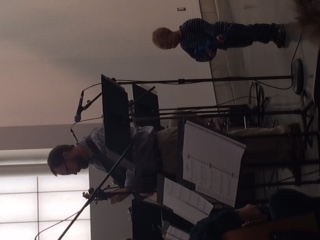
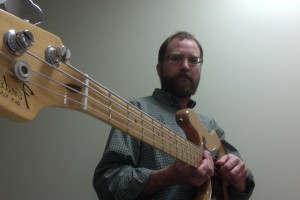
The boys had a snow day today, so when this catchy little tune about growing beards popped into my head, I knew I had to enlist them in making a video. Yes, it is ridiculous. Yes, a good time was had by all.
I grew a beard since you’re gone
I grew a beard—it’s been so long
Since you’ve been here
I grew a beard.
I grew a beard missing you
I grew a beard nothing else to do
But drink too much beer
And grow a beard.
I grew a beard…
I grew a beard down my chin
I grew a beard, it’s kind of thin
But I need a friend
So I grew a beard.
I grew a beard just for you
Though I know deep down we’re through
But I’ll be waiting right here
Growing a beard.
Update: Sheet music for this song
is now available at gregscheer.com.
If you are involved in church music at all, you know there’s a deep divide between “traditional” and “contemporary” music. Don’t get me wrong, the ugly worship wars of the 80s and 90s are mostly over, and people generally see the value in having a wide variety of worship materials. However, the musicians themselves come from very different places: the “traditional” musicians are classically trained note readers who rarely improvise, and the “contemporary” musicians are more comfortable working from recordings and making music off the page.
Part of my mission is to be a bridge between these two worlds. Whenever I find a song from the contemporary world that I think could work in a traditional setting, I make a point of arranging it for non-improvising musicians.
Andy Piercy today
The latest is a four part arrangement of Andy Piercy’s “Comfortable Words.” Andy was part of the band After the Fire, which had a huge impact on me as a teen. (What was not to admire? The were Christians, English, and played New Wave!) Andy and I have become friends in the last year and led a Psalm songwriting workshop together, where Andy sang this song in morning prayer. I thought it would make a good crossover song so I wrote a quick arrangement of it. Nothing fancy, just something a pianist or choir could use to lead the song.
Update: Sheet music for this song is now available at gregscheer.com.
One of my favorite Epiphany hymns is “Brightest and Best of the Stars of the Morning.” Written by Reginald “Holy, Holy, Holy” Heber in 1811, it wonderfully ties together the visit of the Magi with our own offerings to Christ. Most hymnals combine it with the dime-a-dozen tune MORNING STAR, but the 1982 Episcopal hymnal makes a far better choice, pairing it with the outstanding tune from Southern Harmony, STAR IN THE EAST. (Music matters, friends!)
In 2013 the entire song was part of Church of the Servant’s Lessons & Carols service, and since that time we have sung verses 3 and 4 as our offertory hymn during Epiphany. The Southern Harmony harmonization is raw and we needed something that would work for pianists as well as guitar-based ensembles, so I wrote a new arrangement. I must humbly say that it is the best thing since sliced communion bread.
3. Shall we then yield him, in costly devotion odors of Edom, and offerings divine, gems of the mountain, and pearls of the ocean, myrrh from the forest, or gold from the mine?
4. Vainly we offer each ample oblation, vainly with gifts would his favor secure; richer by far is the heart’s adoration, dearer to God are the prayers of the poor.
One of the fun things about having a few songs in hymnals is that I’m introduced to new people via my music. I recently got an email from Jonathan, a music director in Madison, Indiana, asking for permission to introduce “People of the Lord” to his congregation. “Sure,” I said, “as long as I can add the newsletter article and recording to my blog.”
It’s fun to see churches using my music, but what I was most impressed by is that this music director is committed to teaching his congregation new music, introducing a new hymn from Glory to God each month! You can read his monthly updates here: http://www.madisonpresbyterianchurch.org/page/music_ministry.
As I continue to sing through our new hymnal, Glory to God, this month another Psalm paraphrase struck me as being particularly well constructed. “People of the Lord,” #632, is a setting of selected verses from Psalm 78. I think my favorite aspect of this setting is the asymmetric meter. This is just a music-speak way to say that the beats are not all of the same duration. The time signature for this piece is 7/8 (cleverly apropos to a setting of Psalm 78) and is broken down 2+2+3 or short-short-long. The use of asymmetric meter in a Psalm paraphrase hearkens back to the Genevan Psalter. Another wonderful aspect of this Psalm setting is that the verses work in canon. The verses are written from the Psalmist’s perspective and sung in unison (or canon). Unison singing indicates the singular perspective of the Psalmist. The refrain is sung from the perspective of the people of God and is sung in parts. The part singing, then, indicates the plurality of the people of God. Here is a link to a youtube video of the Psalm.
Update: Sheet music for this song is now available at gregscheer.com.
Amid all the “sleeping baby Jesus” songs of the season, we often forget that Jesus had a bumpy start to his life on earth: born away from home, his family was soon on the run again, this time to a foreign country. The only thing he left behind at his birth place was dozens of families whose boys had been killed by Herod, who had hoped to kill Jesus. You can read the whole story in Matthew 2. I assume that most of this was edited out of your Christmas Eve service!
Though the “slaughter of the innocents” and the “flight into Egypt” rarely make it into our Christmas imagination, I’ve been thinking that they may serve an important role for our congregations. Let’s face it: lots of us approach Christmas with dread and depression. We’re far from home, missing loved ones, mourning babies that were never born, or are just so sickened by the reality of the world around us that we have a hard time putting our hearts into a Norman Rockwell Christmas.
With this in mind, I penned “Comfort, Come Again.” (MP3) It’s a prayer that draws on the themes of Matthew 2 and recasts them in a way that they could be prayed and sung for either the characters of the biblical narrative or those of us today who are going through similar griefs and trials.
For all the weeping mothers, fathers;
For every empty chair.
For innocents, like lambs to the slaughter;
For life as thin as air.
Comfort, come again.
For all the starstruck seekers, wanderers,
Wondering why they left.
For all uprooted, fleeing families
Fearful of what’s ahead.
Comfort, come again.
For all the wayward sons and daughters;
For every restless soul;
For all the seekers, mourners, doubters,
Darkness will turn to dawn.
Update: Sheet music for this song is now available at gregscheer.com.
When Cardiphonia released its new Songs for the Incarnation, I eagerly listened through the 23 song collection multiple times. (If you haven’t heard it yet, do yourself a favor and make it the soundtrack to your Christmas festivities.) One of the stand out tracks is Wendell Kimbrough’s “Mary’s Song.” Right away I knew I had to include this thoughtful rendering of the Magnificat in my church’s worship this year.
For my context, though, I needed a written piano accompaniment. And heck, if I’ve got strings and choir available, why not use them? So I wrote this arrangement. Follow the link above for the following:
leadsheet
choral anthem with piano
orchestration with choir and strings